
There is no single legal interval for servicing automatic doors. The law requires powered doors to be kept in efficient working order, BS EN 16005 points to the manufacturer's maintenance instructions, and industry guidance recommends checking the safety functions at least once a year. Busy entrances are usually serviced more often. This guide sets out where each requirement comes from and what a good visit leaves behind.
Key checks
- 01The Workplace Regulations require powered doors to be maintained; no interval is set.
- 02Follow the manufacturer's schedule, and check the safety functions at least once a year.
- 03Staff checks between visits help, but they do not replace a technician's service.
What the law requires
Regulation 5 of the Workplace (Health, Safety and Welfare) Regulations 1992 says workplace equipment "shall be maintained (including cleaned as appropriate) in an efficient state, in efficient working order and in good repair", with a suitable system of maintenance where appropriate. HSE's Approved Code of Practice, L24, lists "powered doors" by name among the equipment that needs one.
Regulation 18 covers the doors themselves. L24 explains that power-operated doors should have safety features to stop people being struck or trapped, such as a sensitive edge or other detector that stops or reverses the door, and a device that limits closing force. It adds that "it should be possible to open a power-operated door or gate if the power supply fails, unless it opens automatically in such circumstances or there is an alternative way through".
None of this names a frequency. The duty is to keep those safety features working, and servicing is how you show they are.
What BS EN 16005 adds
BS EN 16005 is the safety-in-use standard for power operated pedestrian doorsets. The current edition is BS EN 16005:2023+A1:2024; the 2012 edition is withdrawn. It covers sliding, swing, revolving and folding doors, including doors on escape routes and doors that are also fire or smoke doorsets.
The 2023 revision added a clause listing the hazards a risk assessment must consider, tightened the treatment of vulnerable users, changed the finger protection height to 1.9 m and added safeguarding and a test for revolving doors, according to ADSA, the Automatic Door Suppliers Association. ADSA also notes the standard "is not retrospective", so doors fitted before publication need not be rebuilt to it. BS 7036-0:2014 remains the UK code of practice for risk assessment of these doors, and BSI is revising it to match.
On maintenance, the standard puts the frequency in the manufacturer's hands. EDSF guidance on the standard says doors "shall be regularly maintained according to the manufacturer's specification" and recommends checking the safety functions and devices "at least once a year". That guidance was written against the 2012 edition, so treat once a year as a floor rather than a target.
So how often, in practice?
Start from the manufacturer's schedule, then adjust for the door's real life. ADSA's position is that doors "need to be maintained in accordance with the guidance from the manufacturer, this should state what needs to be carried out and the frequency".
The factors that push the interval shorter are the same on every site: how many times a day the door cycles, who uses it (hospitals, care settings and schools carry more vulnerable users), whether it sits on an escape route, and how exposed it is to weather, grit and impact. A quiet internal swing door may be fine on an annual visit; a supermarket or hospital entrance working all day usually is not. Quarterly, six-monthly and annual visits are all common, and the right one should be written into the contract rather than guessed.
If you are not sure how your doors work, the how automatic doors work guide explains the sensors, operator and safety package a service visit is testing.
Checks your own staff can do
ADSA says it is "essential that the occupier carries out frequent safety checks" on powered pedestrian doors, and is equally clear that these "do not replace the inspection and maintenance required by the authorised door technician". A daily walk-through should confirm the door opens in time, does not close on someone standing in the opening and sounds normal.
ADSA describes an occupier's check using a test box of 700 x 300 x 200 mm to confirm the door detects an obstruction in its path. If the door touches the box, strikes someone or behaves differently from yesterday, switch it to a safe mode and call it in. Do not tape over sensors or change settings to keep a door running.
What a service visit should leave behind
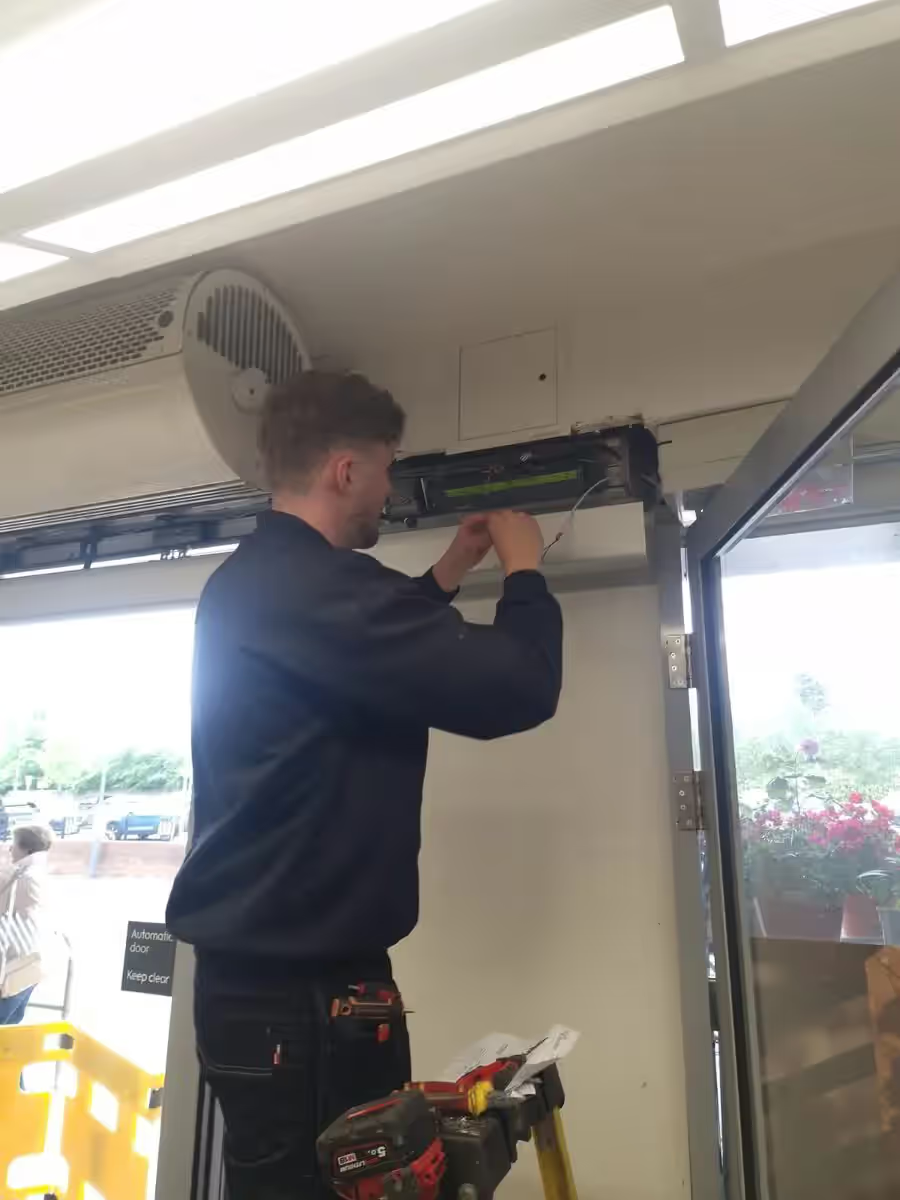
A good visit tests the safety functions, not only the motor: detection zones, force and speed settings, battery back-up, emergency behaviour and any fire alarm link. It ends with a written record of what was tested, what was found and what was adjusted or replaced.
ADSA notes the technician "has a legal requirement to ensure the door system is safe when they leave site", and should stop an unsafe door from operating rather than leave it running. Automatic doors are also machinery. Under the Provision and Use of Work Equipment Regulations 1998, where machinery has a maintenance log, the employer must keep it up to date.
New doors and upgrades
Replacing an operator, or fitting one to an existing manual door, is more than a repair. HSE's L24 says that when new powered doors are installed, "including situations where existing manually operated doors/gates are fitted with powered actuators", they must meet the Supply of Machinery (Safety) Regulations 2008 before first use. BSI notes that BS EN 16005 forms part of the CE and UKCA marking process.
For planned servicing, the maintenance contracts page sets out how visits are scheduled around trading hours. For a door that has already failed, use repairs, and for a new or replacement entrance start on the automatic doors page.